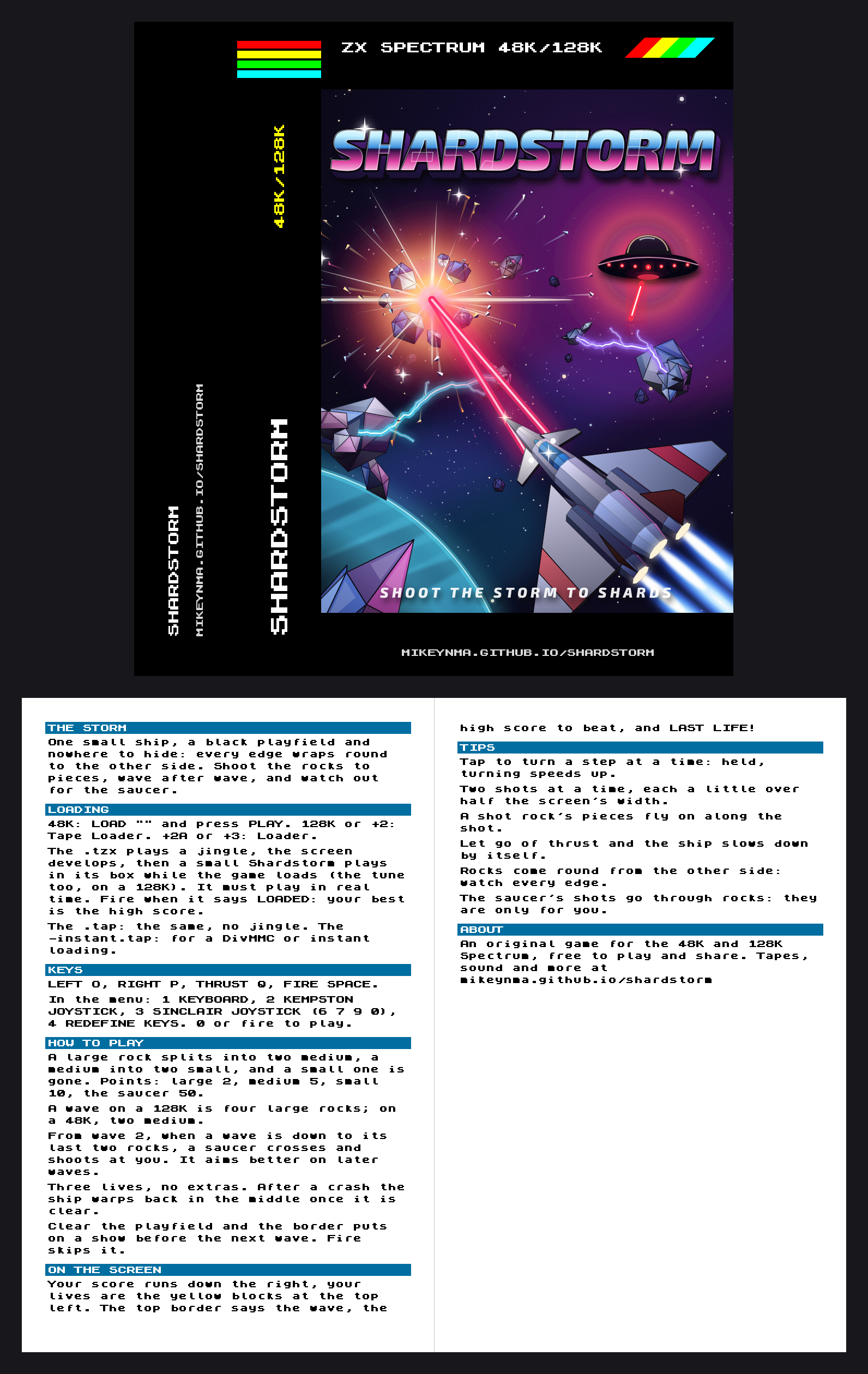
Shardstorm

A rock shooter for the 48K and 128K ZX Spectrum.

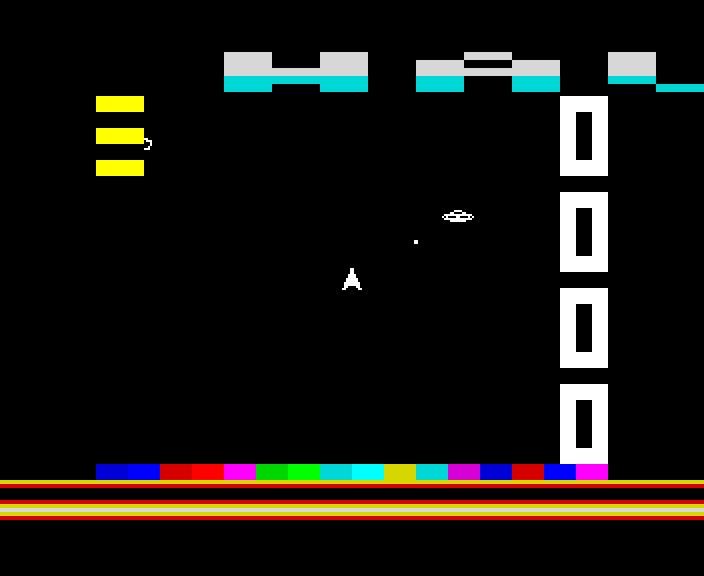
Turn, thrust and fire round a black playfield that wraps at every edge. Rocks split when you shoot them, a saucer comes hunting when they are few, and all the while the border does the showing off: a ticker across the top, bars to the music along the bottom, and a set piece between waves. Free, with a small game to play while it loads.

Filmed in our own emulator, 128K, played by an aiming player.

The game

Rocks, a saucer and the border

A page each on the game, its border and its tape, with screenshots, sound, and the tapes to download.

Loading it

Load the tape

Six files: a tape for each machine, each in three forms. Pick the .tzx if your emulator plays tapes in real time.

Tapes last built: 20 November 2026.

  1. Pick your machine's tape. The 48K tape for a 48K; the 128K tape for a 128K, +2, +2A or +3 (pick Tape Loader, or Loader on a +2A or +3). Each says so if you load it on the other. The loader in the .tzx and .tap has been checked against the 48K's and the 128K's timing; on a +2A or +3, whose timing differs a little, the -instant.tap is the safe one.
  2. The .tzx is the whole thing: a jingle on the tape, the loading screen developing, and a small game to play in its box while Shardstorm loads - with the tune on a 128K. Its own loader reads the tape, so the emulator must play it in real time, as ZX Spin, Retro Virtual Machine and Fuse do: switch off instant and fast loading. Press fire when it says LOADED.
  3. The .tap is the same without the jingle, for an emulator that only takes .tap files.
  4. The -instant.tap is the plain tape, every block for the ROM: for a DivMMC, or an emulator's instant loading, which skip any loader of its own.
  5. On a real Spectrum: play the .tzx into the EAR socket from a TZX player.

Changelog

What's new

About

How it's made

Our own tools

An assembler and a Spectrum emulator written for this work, in JavaScript. The emulator models each machine's timing to the T-state, the 128K's paging and AY chip, and a tape deck that plays the real pulses.

Checked by playing

The build plays the game on a 48K, a 128K and a stand-in for the +2A/+3, and compares every screen it draws with what the game says should be there, pixel for pixel. The tapes are loaded pulse by pulse and the game in the box played to the end.

Then looked at

Every check leaves a screenshot, because a picture shows what a check can miss.