
48K128K13 November 2026
A tape that sings
Before the loading screen, the tape itself plays a short jingle - square-wave notes recorded on the tape, heard through the 48K's speaker or the 128K's TV - and the loader, already listening, never mistakes a note for the start of a block. 48K and 128K.
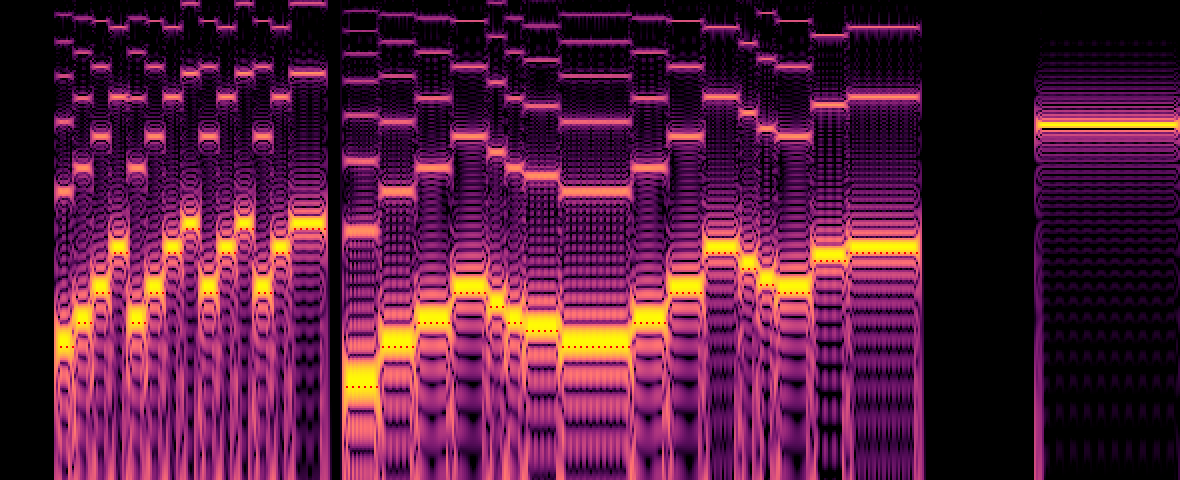
On a 48K the tape's signal reaches the speaker, which is why loading screeches. So a tape can play music just by having music on it. This one plays a 4-second jingle of its own, written for it from Shardstorm's tune, before the loading screen: 30 square-wave notes in E minor, recorded on the tape as plain tones.
the jingle as a 48K's speaker plays it, into the screen's pilot, 6 s
How it works
Notes that never look like a pilot
Our loader is already listening while the jingle plays, and it starts a block when it hears 64 pulses in a row of the pilot's length. A note is a run of equal pulses too - so every note has to be too low to pass for a pilot, even on a tape running as fast as the loader accepts. That puts a ceiling at G4 (392 Hz), which is why the jingle sits low. The build checks it at every speed from 69% to 140%, and that the loader still locks on to the real pilot after the last note.
Heard on the 128K too
The 128K and the +2 have no speaker of their own; their sound goes to the TV, and the tape's signal goes with it - the +2's manual says as much ("you will also hear a varying high-pitched tone"). So the jingle is heard on all of them, through the TV on the later machines.
Only in the .tzx
A .tap can only hold standard blocks, so the .tap here is the same tape without the song, and loads the same way. The .tzx holds each note as a TZX pure-tone block, which an emulator that plays tapes in real time should sound (not yet tried in one).
How it was checked
Checked by shardsing.js on both machines: each note read back from the .tzx and the WAV as written; every one of the jingle's pulses timed by the loader and none taken for a pilot; a sweep of tape speeds; the speaker's sound rendered and each note's pitch measured; then every bit of the load and the game starting, from the TZX, the WAV and a tape 6% fast or slow. Five deliberate faults each make the right check fail - one, a note at the pilot's own pitch, still loads, because the loader recovers, so only the new checks see it. Not yet heard on a real machine.
Screens
As our emulator draws it
Full frames, border and all. Click a picture to see it bigger.


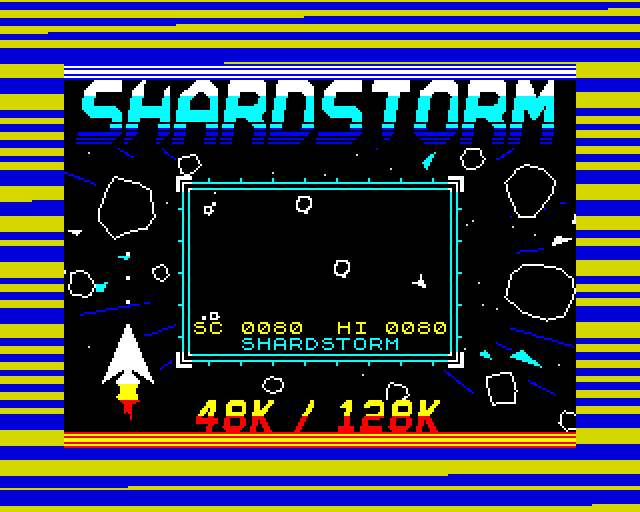
Download
Load it yourself
For the 48K and the 128K. Each machine has its own tape; the .tap is the same tape without the jingle, since a .tap holds standard blocks only.
- In an emulator (ZX Spin, Retro Virtual Machine, Fuse and others): choose the machine the demo says - a 128K or +2 for the 128K ones - and open the
.tzxor the.tap. Use the.tzxwhere you can: the.tapis the same tape without the jingle, since a.tapholds standard blocks only. On a 128K, pick Tape Loader; on a 48K, typeLOAD "". - Switch off instant and fast loading. The custom loaders read the tape signal themselves, edge by edge: an emulator that skips the tape skips the loader, and everything it does while it loads.
- On a real Spectrum: play the
.tzxinto the EAR socket from a TZX player. These are for the original machines' timing: the 48K, the 128K and the grey +2.