
128K13 November 2026
On the AY: both tunes on the 128K's sound chip
Six Voices and Star Tip 2026 again, this time on the 128K's AY chip: three real channels instead of six turns on one bit. The lead has a channel, the bass is a chorused buzzer on another, and the harmony, echo and drums share the third. It is cleaner than the beeper, and the music takes about 2% of the machine.
The 128K has a proper sound chip, the AY-3-8912: three tone channels, a noise generator and one hardware envelope. These are the same two tunes, the same notes and the same envelopes, folded from six voices onto three channels. Only the 128K has an AY; on a 48K these tapes say so and wait.
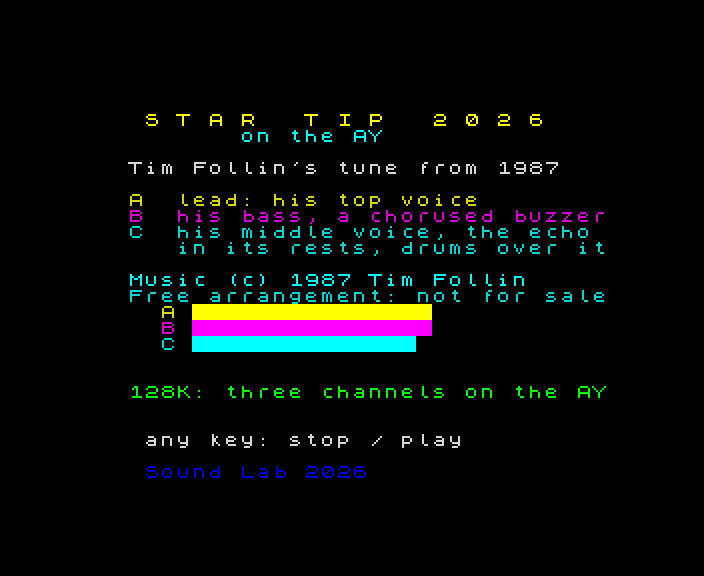
Star Tip 2026's tune is Tim Follin's, © 1987, used as Your Sinclair printed it: free in programs that are not sold. This arrangement is not for sale.
Star Tip 2026 on the AY, 36 s
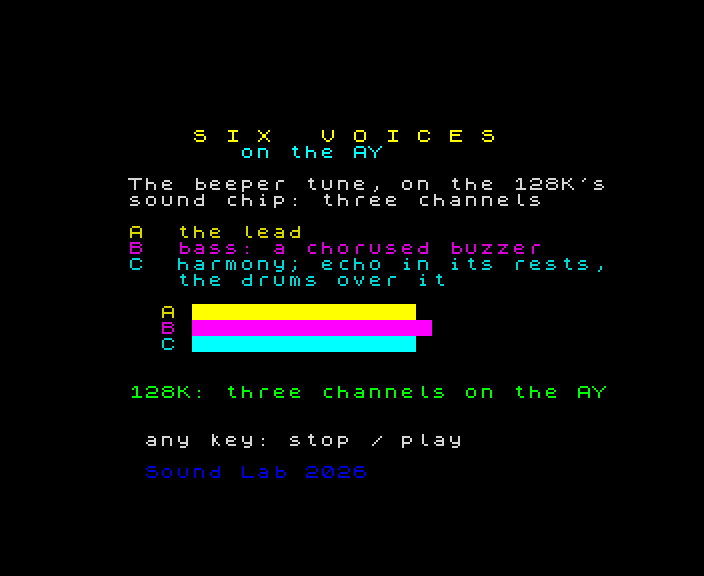
Six Voices on the AY, 63 s
How it works
Six voices onto three channels
The tunes are not written out again. Each is played through the same model of the six-voice engine that checks the beeper version, and every tick of it, all six voices' pitches and volumes, is folded onto the chip. Channel A gets the lead, with its envelope, vibrato and slides. Channel B gets the bass. Channel C holds the harmony, and the echo plays there only where the harmony rests. (A first version had them take turns frame by frame, the chip's usual way of playing two notes on one channel, but in Star Tip both sound nearly all the time, and the 25 Hz flicker was heard as choppy.) The drums go over C: a snare or a hat is the chip's noise laid on the harmony's note, and a kick, a falling tone, takes the channel for three frames.
The chorused bass on one channel
On the beeper the chorus took two voices, the bass and a copy of it 0.9% sharp. Here it is one channel. The bass's tone is gated by the AY's hardware envelope, a repeating falling sawtooth, which is the classic AY "buzzer" bass. The envelope's period is set a fraction sharp of the tone's, so the two slide past each other and the sound slowly changes colour, which is the chorus.
A stream of registers
The player is small: once a frame, after the interrupt, it writes the registers that changed, read from a stream of a two-byte mask and the new values. The music costs about 1,600 T-states a frame, about 2% of the machine. The volume bars on the screen cost more than the music, and a game would leave them out. On the beeper the music takes the whole machine.
The beeper's ticks come about 49 and 52 times a second, the chip's frames 50. Each frame plays the tick that falls in it, so the tempo is the beeper's exactly, and now and then a tick is held for two frames or skipped.
How it was checked
Checked by the Sound Lab's build. Every AY write the Z80 makes, register, value and order, equals the stream's model, frame by frame, for each tune once through and 60 frames into the second time round (3,211 and 1,865 frames). Every frame the lead sounds, its period is checked against the tune's own pitch. A 48K finds no AY and writes nothing to one. A key stops the tune and starts it again, and each tape loads with the 128K's Tape Loader. Not yet heard on a real 128K.
Screens
As our emulator draws it
Full frames, border and all. Click a picture to see it bigger.
Download
Load it yourself
For the 128K. Each machine has its own tape; its .tzx and .tap hold the same blocks.
- In an emulator (ZX Spin, Retro Virtual Machine, Fuse and others): open the
.tapon a 48K or a 128K. On a 128K, pick Tape Loader; on a 48K, typeLOAD "". These are ordinary tapes, so fast loading is fine. - Turn the sound up. On a 48K all six voices come from the beeper; on a 128K the snare also plays on the AY. The AY versions need a 128K or +2.
- Any key stops the tune; another plays it again from the top.
- On a real Spectrum: play the tape into the EAR socket from a tape player or a TZX player.