
Next Sound Lab

Music for the Next's DACs, played by the Copper.

Eight sampled voices, mixed in Z80N twice a frame. The Copper writes a byte to the left and right DACs on every scan line, and the DMA plays a centre channel on two more. That is 15,351 Hz stereo with no CPU time spent on output. It plays an 80-bar song of our own, under a 90s-style demo that runs at the full frame rate.

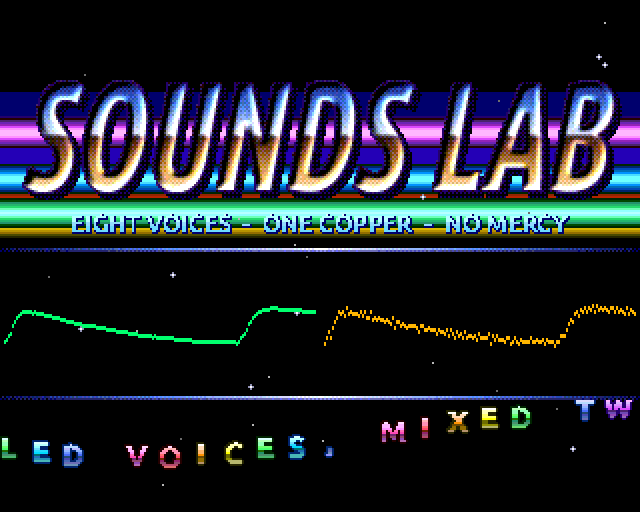
The chrome SOUNDS LAB logo over coloured copper bars, the tag line EIGHT VOICES - ONE COPPER - NO MERCY, a green and amber oscilloscope, and a rainbow scroller
The chrome logo over copper bars drawn by the same Copper list that plays the music. Below it, an oscilloscope of the bytes being played: left in green, right in amber.

The demo

Listen, then load it

A recording to play here, the whole demo to watch, a .nex for a Next or an emulator, and a page on how it works.

Next1MB13 November 2026

Eight Voices, One Copper

A song of our own in the late-80s hip-house style: 80 bars at 123.4 BPM, with synthesised drums, bass, stabs, strings and a lead, and shouted vocals. Around it runs a demo of stars, copper bars, an oscilloscope, a sine scroller, a plasma with 48 bobs and a tunnel, all following the music. The sound takes 26% of the CPU on average.

the song once through, recorded from the emulated Next, 2 min 36 s

The whole demo, with its sound, as the emulator JNEXT ran it: 2 min 37 s. Turn it up: it was recorded quietly and raised by 20 dB.

Playing it

Load the .nex

One file. It runs on any ZX Spectrum Next with 1MB, and needs no Raspberry Pi. The music starts as soon as it loads, and loops until you reset.

sounds-lab.nex, 13 November 2026, 576 KB

  1. On a Next: copy sounds-lab.nex to the SD card, find it in the Browser and press ENTER. Not yet tried on a real Next.
  2. In CSpect (with the Next's ROMs in its folder, as its readme says): CSpect.exe -zxnext -s28 -w3 sounds-lab.nex.
  3. Turn the sound up. It is on the quiet side.
  4. Made and checked at 50 Hz. The song ticks once a frame, so at 60 Hz it would play faster.

Changelog

What's new

About

How it's made

Our own engine, in Z80N

The mixer, the song player and the demo are written from scratch in Z80N assembly. The song, its sounds and the demo's pictures are made by our own Python scripts.

Checked byte for byte

A Python model of the mixer plays the same song. Every byte the Next wrote to its DACs in the emulator JNEXT, 10,283,268 of them, matched it, over the whole song with the demo running.

Then listened to, in CSpect

A check can pass and still sound wrong, so the demo was also run in the CSpect emulator and listened to. It played as it should. It has not yet been heard on a real Next.